01
Entity profiling
Characters, places, recurring objects, and motifs are extracted and named consistently before any translation work begins.
Context-aware literary translation
Dano builds a knowledge graph of your text before translation begins - tracking characters, motifs, and narrative pressures so decisions stay coherent across every paragraph.
How it works
Characters, places, recurring objects, and motifs are extracted and named consistently before any translation work begins.
Entities and their relationships are mapped into a structured graph. Narrative pressure, tone, and cultural weight are recorded as graph properties.
Each paragraph is translated with the full graph in view - not in isolation. Terminology, register, and voice stay consistent chapter to chapter.
Translators and editors see the same graph slice used during translation, making quality review grounded rather than intuitive.
Clean EPUB and structured JSON output, ready for editorial pipeline or downstream localization systems.
Sample library
Als Gregor Samsa eines Morgens aus unruhigen Träumen erwachte, fand er sich in seinem Bett zu einem ungeheuren Ungeziefer verwandelt. Er lag auf seinem panzerartig harten Rücken und sah, wenn er den Kopf ein wenig hob, seinen gewölbten, braunen, von bogenförmigen Versteifungen geteilten Bauch, auf dessen Höhe sich die Bettdecke, zum gänzlichen Niedergleiten bereit, kaum noch erhalten konnte. Seine vielen, im Vergleich zu seinem sonstigen Umfang kläglich dünnen Beine flimmerten ihm hilflos vor den Augen.
»Was ist mit mir geschehen?« dachte er. Es war kein Traum. Sein Zimmer, ein richtiges, nur etwas zu kleines Menschenzimmer, lag ruhig zwischen den vier wohlbekannten Wänden. Über dem Tisch, auf dem eine auseinandergepackte Musterkollektion von Tuchwaren ausgebreitet war – Samsa war Reisender –, hing das Bild, das er vor kurzem aus einer illustrierten Zeitschrift ausgeschnitten und in einem hübschen, vergoldeten Rahmen untergebracht hatte. Es stellte eine Dame dar, die, mit einem Pelzhut und einer Pelzboa versehen, aufrecht dasaß und einen schweren Pelzmuff, in dem ihr ganzer Unterarm verschwunden war, dem Beschauer entgegenhob.
When Gregor Samsa awoke one morning from troubled dreams, he found himself transformed in his bed into a monstrous vermin. He lay on his armor-hard back and, if he lifted his head a little, saw his domed brown belly, divided into arched, rigid segments, atop which the quilt, ready to slide off completely, could barely maintain its hold. His many legs, pitifully thin in comparison to the rest of his bulk, flickered helplessly before his eyes.
“What has happened to me?” he thought. It was no dream. His room, a proper, albeit somewhat overly small human room, lay peacefully between its four familiar walls. Above the table, upon which an unpacked sample collection of fabric goods was spread out—Samsa was a traveling salesman—hung the picture he had recently cut from an illustrated magazine and fitted into a handsome gilded frame. It depicted a lady, equipped with a fur hat and a fur boa, sitting upright and raising a heavy fur muff, into which her entire forearm had vanished, toward the viewer.
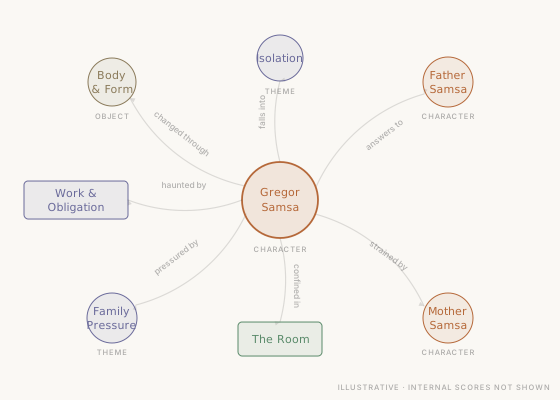
Dano does not translate paragraphs as isolated strings. It first builds a structured memory of the book's characters, spaces, motifs, and pressures.
This public map is illustrative. The production graph contains richer properties, ranking, and retrieval logic that stay private.
Dano Systems is a small team building context-aware translation tooling for literary and high-stakes texts. We work at the intersection of knowledge graph engineering, applied LLMs, and editorial craft.
The name comes from the Persian دانو - a word for knowledge, flow, and river. The work is about keeping meaning coherent across languages, chapters, and contexts.
Get in touch
Describe the text, source and target languages, and what's made it difficult so far. I'll respond within a few days.